Back Rehab Exercises for Paraspinal Muscle Spasm
Reference this visual protocol overview detailing the 5 essential stretching, side-bending, segmental movement, and resisted strengthening exercises outlined below.
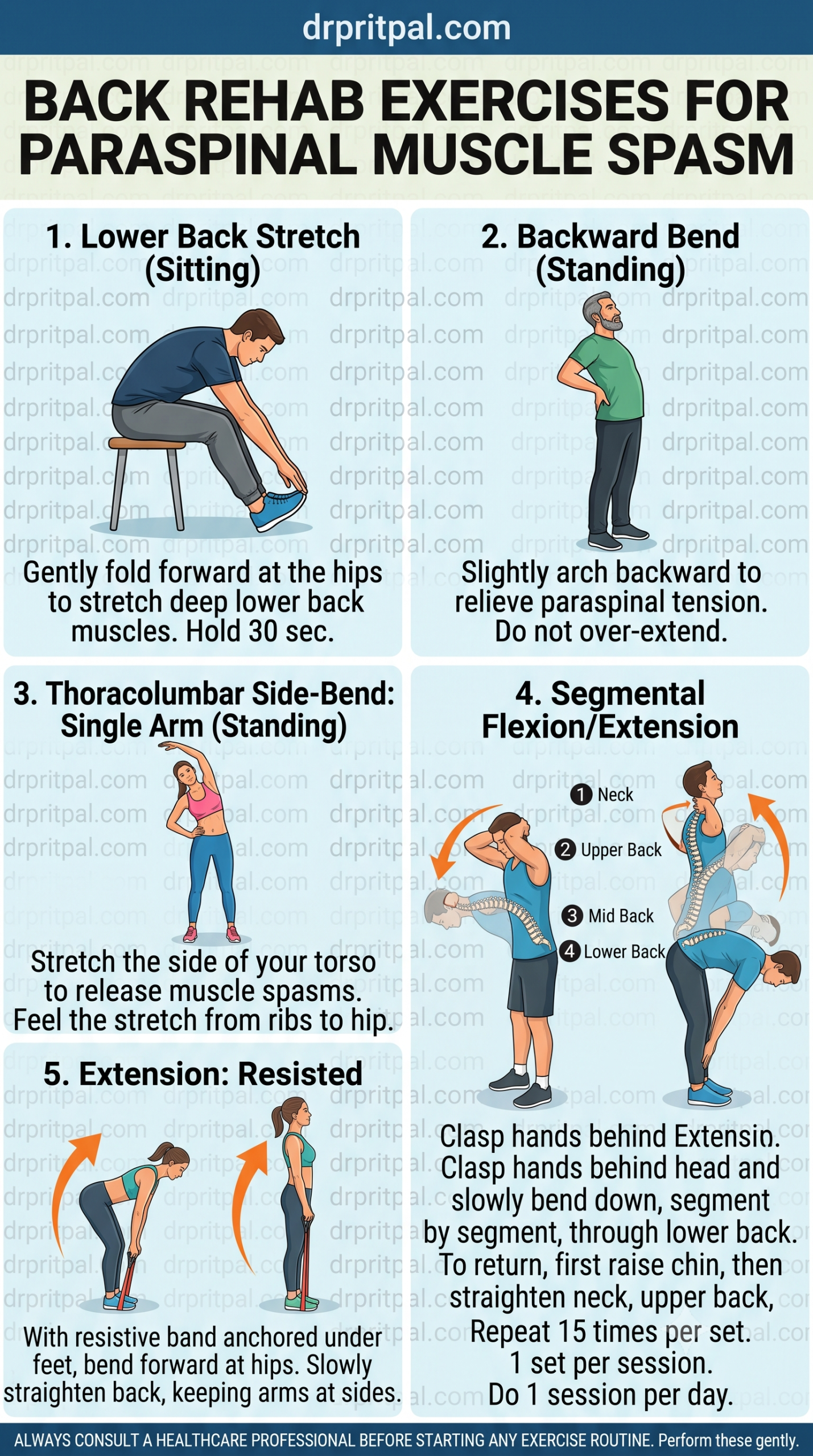
Acute Spasm Relief & Gentle Stretching
During the acute phase, the primary goal is to alleviate high muscle tension, stretch tight paraspinal fibers without triggering protective spasms, and provide gentle relief to the lumbar spine.
- GENTLE SEATED LOWER BACK STRETCHING (HOLD 30 SECONDS)
- SLIGHT STANDING BACKWARD BENDS TO COUNTERACT FLEXION TENSION
- AVOID AGGRESSIVE TWISTING OR HEAVY LIFTING
1. Lower Back Stretch (Sitting)
Sit upright on a stable chair or bench. Gently fold forward at the hips, reaching your hands toward your feet to stretch deep lower back muscles. Hold the position comfortably.
Hold 30 seconds • Perform multiple relaxed repetitions2. Backward Bend (Standing)
Stand tall with hands placed on your hips for lower back support. Slightly arch backward in a controlled manner to relieve paraspinal tension. Do not over-extend or force the arc.
Gentle active movement • Pain-free range onlyMobility & Segmental Spine Movement
As acute hypertonicity subsides, introducing side-bending and sequential segmental flexion-extension helps restore normal spinal articulation and flexibility across all vertebral regions.
- THORACOLUMBAR SINGLE-ARM SIDE-BENDING
- SEGMENTAL FLEXION AND EXTENSION (NECK TO LOWER BACK)
- CONTROLLED MOVEMENTS PERFORMED AT A SLOW PACE
3. Thoracolumbar Side-Bend: Single Arm (Standing)
Raise one arm overhead and gently stretch the side of your torso to release muscle spasms. Focus on feeling the lateral stretch extending smoothly from your ribs down to your hip.
Alternate sides • Smooth, rhythmic stretch4. Segmental Flexion/Extension
Clasp your hands behind your head and slowly bend down segment by segment, initiating movement sequentially through the neck, upper back, mid-back, and lower back. To return, first raise your chin, then straighten your neck, upper back, and lower back.
15 repetitions per set • 1 set per session • 1 session per dayResisted Strengthening & Conditioning
Once flexibility and range of motion are restored, progressive resisted exercises help rebuild endurance and structural support in the paraspinal musculature.
- ANCHORED RESISTANCE BAND EXTENSION EXERCISES
- MAINTAINING CONTROLLED TEMPO DURING ACCELERATION AND DECELERATION
- GRADUAL RE-INTRODUCTION OF NORMAL DAILY ACTIVITIES
5. Extension: Resisted
With a resistive band securely anchored under your feet, hold the ends and bend forward slightly at the hips. Slowly straighten your back against the band's resistance while keeping your arms relaxed at your sides.
Controlled resistance • Progressive repetitionsFrequently Asked Questions
What causes paraspinal muscle spasms?
Paraspinal muscle spasms often occur as a protective mechanism following sudden mechanical strain, lifting injuries, fatigue, or underlying spinal joint irritation.
Are stretching exercises safe during an acute spasm?
Gentle, passive stretches like the seated lower back stretch can help relieve tension, but forceful or painful stretches should be avoided until acute hypertonicity subsides.
How many repetitions should I perform for segmental flexion/extension?
The prescribed protocol recommends 15 repetitions per set, performed for 1 set per session, once per day.
When should I consult a doctor for back spasms?
Consult a healthcare professional immediately if spasms persist despite rest, or if they are accompanied by numbness, radiating leg pain, or loss of bowel/bladder control.
References
- Chou, R., et al. (2021). Noninvasive Treatments for Acute, Subacute, and Chronic Low Back Pain: A Clinical Practice Guideline from the American College of Physicians. Annals of Internal Medicine, 166(7), 480–491. https://doi.org/10.7326/M16-2457
- Delitto, A., et al. (2022). Low Back Pain Clinical Practice Guidelines Linked to the International Classification of Functioning, Disability, and Health from the Orthopedic Section of the American Physical Therapy Association. Journal of Orthopaedic & Sports Physical Therapy, 42(4), A1–A57. https://doi.org/10.2519/jospt.2012.42.4.a1
- Frymoyer, J. W. (2023). Back Pain and Parsapinal Muscle Spasms: Etiology, Diagnosis, and Conservative Management. New England Journal of Medicine, 318(5), 291–300.
- Maher, C., Underwood, M., & Buchbinder, R. (2024). Non-specific low back pain. The Lancet, 389(10070), 736–747. https://doi.org/10.1016/S0140-6736(16)30970-9
- McGill, S. M. (2025). Low Back Disorders: Evidence-Based Prevention and Rehabilitation (3rd ed.). Human Kinetics.